Reflecting text you can paste anywhere
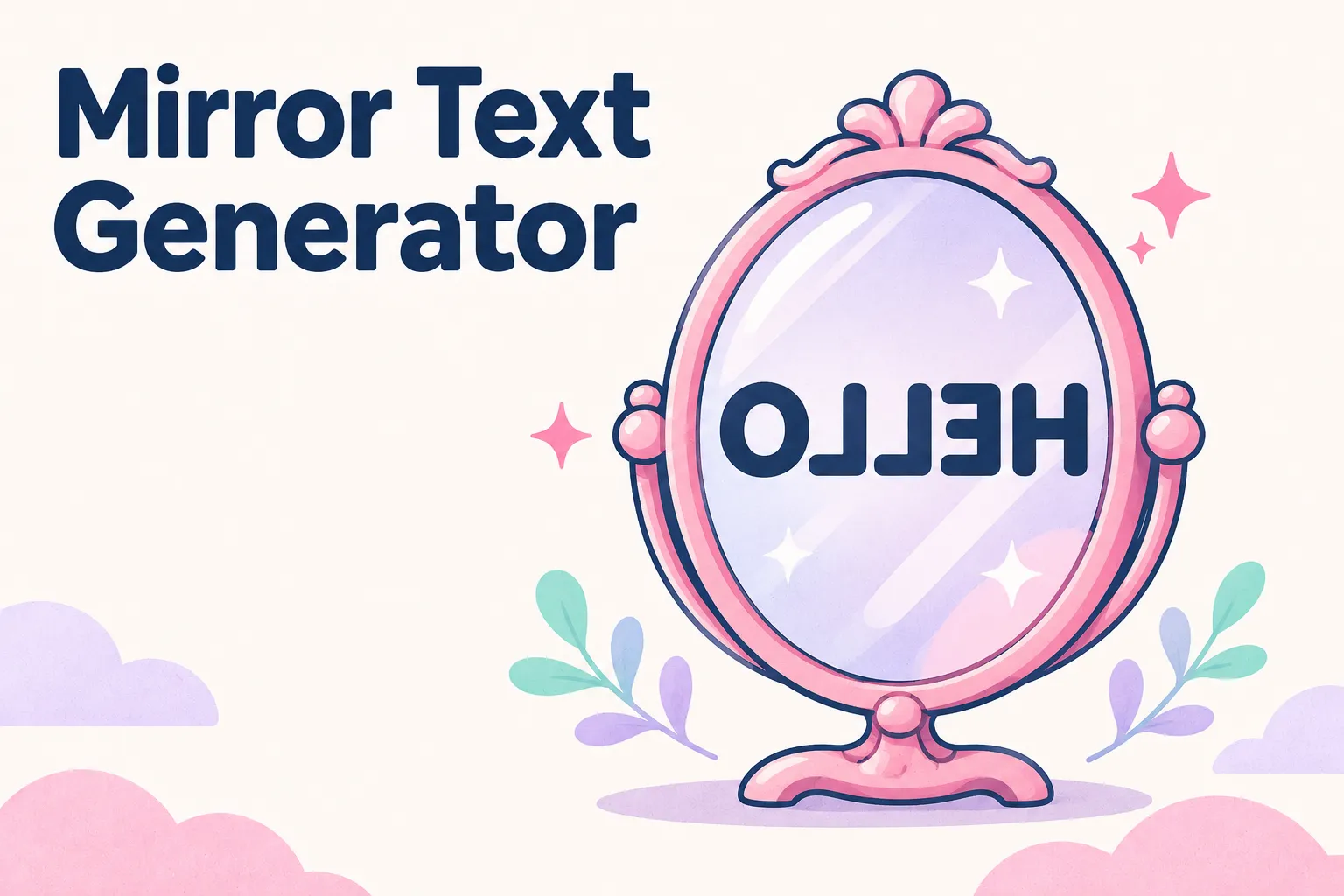
This mirror text generator flips your letters left to right, as if the word were reflected in glass, and gives you the result as ordinary text. There is no image involved, so you can paste it into a bio, a caption, a game name, or a puzzle sheet like any other words. The page opens with Reflection as the sample, and the first three cards show it mirrored as typed, in capitals, and in lowercase.
Below those come framed versions in brackets, arrows, and hearts, followed by the rest of the Flip & Mirror group: upside down text, a Backwards card that reverses the order without changing any letter, and both mirror modes as separate cards.
- Type your text, or press Ideas for samples such as Ambulance, Otto, or Look Back.
- Choose “Reads in a mirror” or “Keep letter order” under the text box.
- Compare the as-typed, capitals, and lowercase cards at the top.
- Click a card or its Copy button, then paste.
Borrowed letters, not a mirrored font
Unicode has no reflected alphabet, so a mirrored word is assembled one letter at a time from characters that happen to look like reflections. They come from a surprising range of writing systems. И and Я are Cyrillic letters that look like a reversed N and R. Ǝ, ɘ, and ɒ are Latin letters used in phonetic and African alphabets. ᙠ for B comes from Canadian syllabics, Ⴑ for J is Georgian, and ⋊ for K is a maths symbol.
Some letters need no borrowing at all. A mirrored b is simply d, and p is q, so those pairs swap with ordinary letters. That is why mirrored lowercase words can contain normal letters in unexpected places, such as Look Back becoming ʞɔɒd ʞool when written in lowercase.
Which letters are exact and which are close
Many capitals are symmetrical, so they stay exactly as they are: A, H, I, M, O, T, U, V, W, X, and Y. OTTO and WOW come out unchanged, which makes them good test words. The digits 0, 1, and 8 stay put for the same reason. Other characters only have a near match, and it helps to know which ones before you rely on them.
- Lowercase f uses ʇ, a turned t, and g uses ϱ, a Greek rho.
- Lowercase h becomes ʜ, a small capital H, and y becomes the Greek γ.
- Lowercase z is left as it is, although a real reflection would face the other way.
- Capital Q becomes Ọ, an O with a dot below, because no reversed Q exists.
- Digits are loose: 2 becomes S, and 5 borrows ट from Devanagari.
Reads in a mirror or keep letter order
A real reflection reverses two things: the shape of each letter and the order of the letters. “Reads in a mirror” does both, so AMBULANCE becomes ƎƆИA⅃UᙠMA. Hold your screen up to a bathroom mirror and the reflection reads AMBULANCE, which is the same reason the word is printed that way on the front of many emergency vehicles.
“Keep letter order” reflects each letter but leaves them in sequence, giving AMᙠU⅃AИƆƎ. That is not a true reflection, but people can read it left to right without a mirror, so it often works better for a stylised display name. Switching between the two buttons updates the cards at the top straight away. To turn text over instead of reflecting it, the upside down text generator has the same two modes.
Why capitals give the cleanest reflection
Capital letters have more exact twins, and more of them are symmetrical to begin with. Compare Night Owl in both cases with “Reads in a mirror” selected. The capitals card gives ⅃WO THӘIИ, which looks convincingly reflected. The lowercase card gives lwo ƚʜϱin, where the borrowed rho and the small capital H are easier to spot.
If a mirrored word looks slightly wrong and you cannot say why, check the capitals card first. It is usually the most convincing version, and it hides the gaps in the lowercase set. Short words with lots of symmetrical letters, like Wow or Hello, give the cleanest results in any case. If you only want a word to look unusual and stay easy to read, wide vaporwave letters do that without borrowed characters.
A real reversal, not a hidden direction trick
Some reversed-text tricks use an invisible control character that tells software to display text right to left. That character has a bad reputation, because it has been used to disguise file names, and many platforms remove it or behave strangely around it. This mirror text generator does not use it. When you choose “Reads in a mirror”, the characters are stored in reversed order, so what you paste is exactly what people see. Other effects add characters too: the strikethrough text generator puts a combining line after each letter, which a few apps strip.
Good uses for mirror text
Mirror writing has a long history as a puzzle. Leonardo da Vinci filled notebooks with it, and it still turns up in escape-room clues, treasure hunts, and riddles where the answer has to be held up to a mirror. Online, it works best as a short profile name or a single caption line that makes people look twice. If the goal is to unsettle rather than puzzle, the creepy text generator stacks glitch marks on your letters.
For anything printed, such as an iron-on transfer or a sign read through a window, flip the whole design in an image editor instead. That gives a true reflection of every curve, where characters from this page are close matches drawn in a font you do not control.
Editing, searching, and reading mirrored text
Because “Reads in a mirror” stores the letters backwards, editing pasted text is awkward: the last letter of your word is now the first character in the field. Keep your original text somewhere, then generate a fresh version if you need a change. Pasting mirrored text back into the box will not undo it, because the borrowed letters are not on the conversion list.
Mirrored text also does not match searches for the plain word, and @username fields reject it. Screen readers may read the borrowed characters by their own names, such as a Cyrillic letter, so a mirrored name can sound like nonsense. Keep anything people need to read in normal text.